Emily Conlon


Desire Paths
Created during the RBC Emerging Artist in Residence program at Art Windsor Essex, 2026.


Exhibition Statement
This exhibition uses the phenomenon of desire paths as an entry point to reflect on how movement, time, and collective experience become embedded into the physical landscape. A desire path is an unplanned route or path (such as one worn into a grassy surface by repeated foot traffic) that is used by pedestrians in preference to, or in the absence of, a designated alternative (such as a paved pathway). Formed slowly and through repetition, these paths act as records of time and memory imprinted on space.
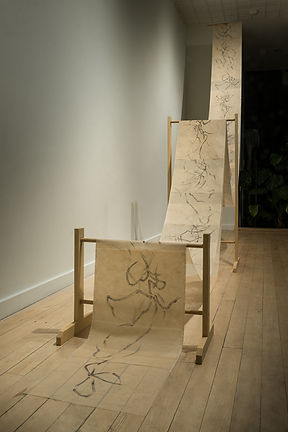
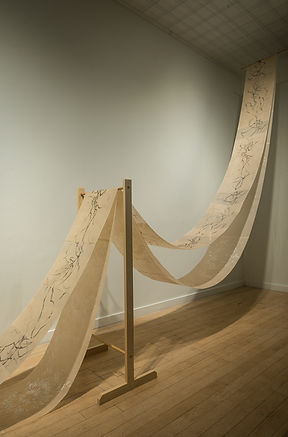
The imagery in the installation references both kinetic gestures and organic plant matter, abstracted and accumulating as repeated marks that come together to form a worn, distinct pathway. Similar to the human impulse to defy barriers, this work reflects on the parallels that occur in natural environments when organic materials spread, adapt, and reclaim space in environments that attempt to contain or redirect them.
Printmaking is central to this installation, as the act of embedding an image into paper references the physical impressions left on a landscape through repeated passage. In contrast with the structural elements in the installation that reference physical barriers or interruptions, the printed pathways emphasize impulse over imposition, pointing to the quiet persistence of intuitive movement in environments that often prioritize order, efficiency, and control.
Curatorial Statement
Rebecca Solnit reminds us that “a path is a prior interpretation of the best way to traverse a landscape,” and nowhere is this more true than in those well-worn but unofficial “desire paths” that mark our urban landscapes. Emily Conlon, an award-winning artist and printmaker working in Windsor, Ontario, poetically illustrates how these unruly pathways offer us a metaphor to understand the natural world. Conlon’s remarkable, sinuous installation offers us a glimpse of how natural organisms—ourselves included—adapt to environments that are not always built to encourage our wanderings. At a difficult historical juncture, this work reminds us to be more gentle with those whose paths don’t always conform to society’s expectations.
The RBC Emerging Artist in Residence program is an opportunity to celebrate the significant accomplishments of emerging regional artists. It was a delight to have Emily Conlon working in AWE’s Education Studio these past three months, generously sharing her meticulous work with our public. We look forward to following Conlon’s work for many years yet to come.
—Emily McKibbon, Head, Exhibitions and Collection, Art Windsor Essex

Photos by Frank Piccolo